A branded espresso cup that photographs beautifully and cracks in its third week of service is a failure, no matter how good the logo looked. Café use is brutal in a specific way: the same small cup gets pulled from a cold stack, filled with a scalding pour, run through a high-temperature dishwasher, and stacked again, dozens of times a day, for years. Specifying a cup that survives that is a different job from choosing one that looks right, and it comes down to a handful of measurable properties and one line of food-safety compliance you cannot skip.
Thermal shock: surviving hot pours from a cold stack
The first thing that kills a café cup is temperature change. Ceramic expands when heated, and if one part of a cup heats faster than another, the stress can craze the glaze into fine cracks or split the body outright. That is thermal shock, and it is exactly what happens when a cup stored cool takes a hot pour, then meets a hot wash minutes later. The defense is a vitrified body: fired hot enough that the clay particles fuse into a dense, glassy structure that absorbs very little water, typically under about half a percent. A vitrified cup carries less moisture in its walls to flash and expand, and it distributes heat more evenly, so it shrugs off swings that would craze a lower-fired earthenware.
This property is testable, not a marketing word. European standard EN 1183 covers thermal shock and endurance for food-contact ceramics, ASTM C554 measures a glaze’s resistance to crazing under repeated temperature cycling, and ASTM C368 assesses impact strength. When you are buying for service rather than display, ask whether the cups are vitrified and whether they have been tested against a recognized thermal-shock method. A supplier who can answer that is selling you hardware built for a café, not a gift shop.
Chips and the rim: where cups actually die
Most cups do not shatter dramatically; they die by a thousand small chips, almost always at the rim or foot. The rim takes every clink against a saucer, every knock in a bus tub, and every collision when cups are stacked wet and in a hurry. Two things decide how long it lasts. The first is the body: a dense vitrified porcelain resists impact far better than a soft, porous one, which is why hospitality buyers pay for hotelware-grade cups. The second is rim geometry. A rolled or reinforced rim, slightly thickened and rounded rather than thin and squared, spreads impact instead of concentrating it at a sharp edge, and it noticeably extends the service life of a cup that gets handled roughly. A thin, elegant rim photographs well and chips early; a subtly reinforced one survives the bus tub. For a café program, favor the reinforced rim and treat a low chip rate as the durability number that actually shows up in your replacement budget.
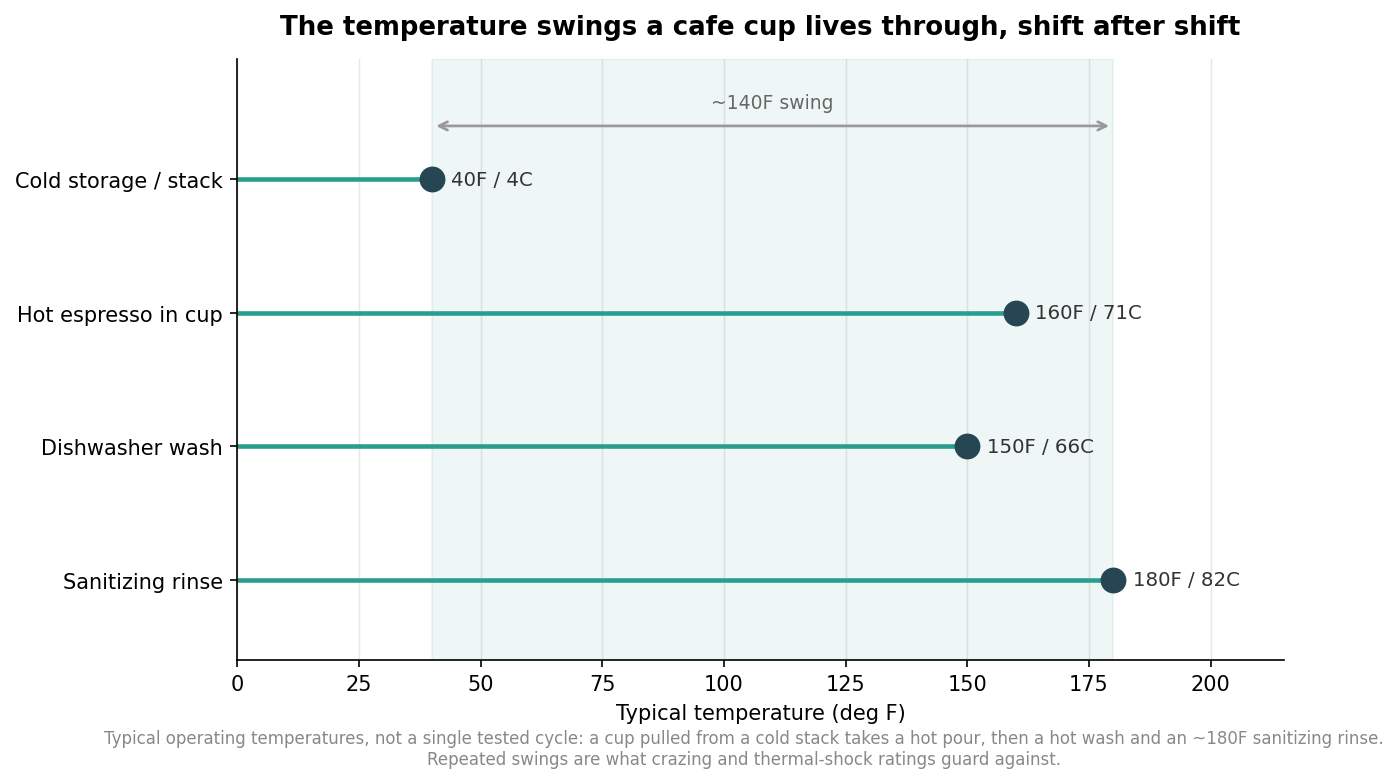
The temperature chart above is why all of this compounds. A café cup does not sit at one temperature; it swings roughly a hundred and forty degrees between a cold stack and a sanitizing rinse, over and over. Each swing is a small thermal-shock event and each stack-up is a small impact event, and a cup that is merely adequate at either one will find its limit fast under the repetition. Durability in a café is not about surviving one hard knock; it is about surviving the ten-thousandth ordinary one.
The dishwasher and the logo
Commercial warewashing is harsher than any home kitchen. A high-temperature machine finishes with a sanitizing rinse around 180 degrees Fahrenheit, roughly 82 Celsius, and cups go through it every day. That heat, plus aggressive detergents, is what fades a printed logo over months, and it is why decoration method matters as much as the artwork. Decoration applied over the fired glaze sits exposed to every cycle and wears; decoration fired into or under the glaze is protected by the glass layer above it and survives far longer. If a café wants a logo that still looks sharp after a year of service, the branding needs to live below the glaze surface, not on top of it. This is the single biggest driver of whether a cup looks new or tired at its first anniversary.
Glaze integrity also feeds back into durability. A fully glazed, evenly covered surface resists staining from coffee oils and is easier to keep hygienic than a matte or unglazed patch, and it gives the decoration a stable home. When you evaluate a sample, run it through your own dishwasher cycle a few dozen times before you commit; a decoration that dulls in your test kitchen will not improve at scale.
The safety line you can’t skip
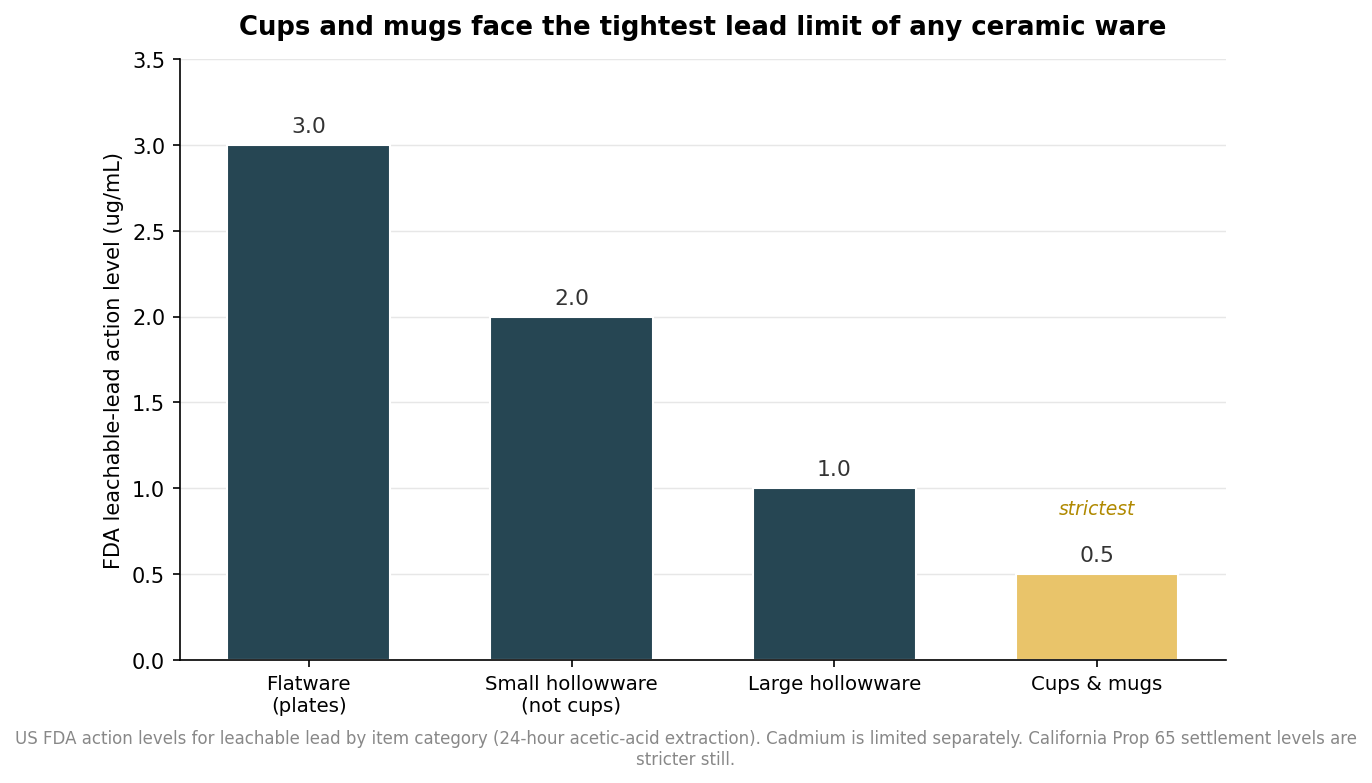
Because a cup touches the mouth, it faces the strictest food-contact rules of any tableware, and decorated cups carry the most risk. Colored glazes and over-glaze decoration have historically been a source of leachable lead and cadmium, and regulators single out drinkware accordingly. Under US FDA action levels, cups and mugs must not leach more than 0.5 micrograms of lead per milliliter in the standard acetic-acid extraction test, the tightest lead limit of any ceramic category, and cadmium is capped separately. California’s Proposition 65 pushes tighter still, and international buyers meet the ISO 6486 series or the EU’s equivalent limits. The higher-risk zone is decoration near the rim, exactly where the mouth contacts the cup, so a colored band or a metallic line at the lip deserves particular scrutiny.
The practical protection is documentation. Ask any supplier for current lead-and-cadmium migration test reports for the specific glaze and decoration you are ordering, not a generic certificate for a different product, and confirm the tests cover the rim decoration if you have any. In-glaze and under-glaze decoration, sealed beneath the glass layer, is generally the safer as well as the more durable choice, which is a convenient alignment: the decoration that lasts is usually the decoration that leaches least.
Put together, a café-tough espresso cup is a short, specifiable list: a vitrified body tested for thermal shock, a reinforced rim to resist chipping, in-glaze or under-glaze branding that survives the sanitizing rinse, and current lead-and-cadmium test reports covering the exact decoration. None of these show up in a photograph, and all of them show up in your replacement rate and your liability exposure a year in. Specify them up front and the cup that looks good on day one is still the cup that performs on day four hundred.